Weekly Report of China Export Container Transport Market
(CCFI Commentary in Issue 11, 2011)
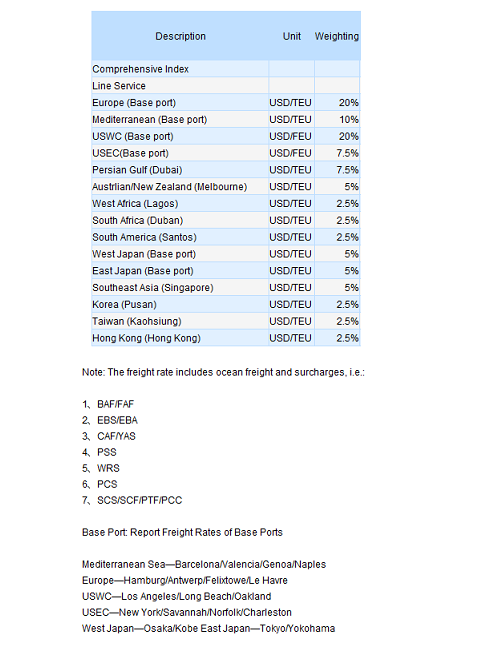
This week, the China containerized transport market marginally went down, with weak demands and freight rates continued in most of the services. On March 11th, the China Containerized Freight Index Issued by Shanghai Shipping Exchange came out at 1027.90 points; while the Shanghai Containerized Freight Index broke through 1000 points threshold to the 993.99 points, down 2.9% from last week.
In Europe and Mediterranean services the inadequate demand, as well as the overcapacity, were still pulling down the freight rate, as on March 11th, the freight rate (ocean freight plus surcharges) for the voyages from Shanghai to base ports in Europe and Mediterranean quoted USD 1076/TEU and USD 1042/TEU, respectively down 22% and 15% comparing to the early of the year. Insiders indicated that the slumping freight rate since this year had almost turned the profits generated from the rate restorations in last year to be “vain”. Meanwhile, jumped to the 29 months high, the bunker price had rendered a significant impact on the carriers’ operating cost according to the latest statistics from Alphaliner. So how would the freight rate perform next basically determine the income of the carriers in the 1st quarter.
The capacity demand was still proved slack in North America service, where the slot utilization remain at 70% and the freight rate kept sliding. On March 11th, the freight rates for the voyages to the US west coast and US east coast were USD 1654/FEU and USD 2862/FEU, respectively shrunk by 4.8% and 3.2% from last week.
Volume appeared to rebound on the Australia and Singapore services, as the slot utilization soared to about 75%, while some even showed 80%. Still, the capacity surplus left unchanged, and the freight rate dropped to USD 700/TEU, some of the voyages even saw it below USD 650/TEU. On March 11th, the freight rate (ocean freight plus surcharges) for the voyages from Shanghai to base ports in Australia and Singapore showed USD 745/TEU, down 3.6% from last week. Pundits believe not only the low production caused by the post-lunar new year softened the cargo volume, but the extreme stagnancy of the residents’ spending will in Australia, where the Consumer Confidence Index in March was reported to fall by 2.4% from previous month, resulting an abundant retailing stockpile and the decreasing order for the China’s manufacturers.
In Persian Gulf service, some of the ships were hard to remain unscathed as the rampant Somali piracy frequently occurred in Fareast, Persian Gulf, and the Red Sea, adding up carriers’ risk and cost. Thanks to these pirates, carriers were poised to impose a WRS (Wars Risks Surcharge), pricing at USD 40/TEU. On March 11th, the freight rate of the voyages to the Persian Gulf service reflected USD 726/TEU.
The skyward international oil price forced carriers to speculate on the Bunker Surcharges. Those running on the Southeast Asia services were reported to have implemented an EBS (Emergency Bunker Surcharge) already in this month, quoting about RMB 900/TEU; while the carriers on the North America services introduced Bunker Surcharges of USD 100/FEU in US west coast and USD 200/FEU in US east coast. Also, freight rate over Africa service and South America service were uplifted as well.


viernes, 18 de marzo de 2011

viernes, 11 de marzo de 2011
TUI Sells Hapag-Lloyd Stake to Albert Ballin, Approves IPO
TUI AG (TUI1), the German tour operator that owns almost half of Hapag-Lloyd, sold part of its stake to the container line’s other shareholder and said it may sell more through an initial public offering.
TUI, which owns 49.8 percent of Hapag-Lloyd, will sell an 11.33 percent stake to Albert Ballin GmbH for 315 million euros ($439 million), the Hanover, Germany-based company said in a statement today. The price may increase by as much as 35 million euros if an IPO takes place, providing “certain conditions are met,” according to the statement.
TUI’s supervisory board authorized the executive board to sell more of Hapag-Lloyd through an IPO, the statement said, without providing further details. An IPO of the container line is scheduled to happen by April 15 and will raise 1 billion euros to 1.5 billion euros, according to two people familiar with the matter. That may give a valuation of 2.8 billion euros to 3.5 billion euros, depending on demand, the people said.
The stake sale “is good news, as it values TUI’s Hapag- Lloyd stake at almost 1.8 billion euros,” or about 2 billion euros including the potential premium from an IPO, said Stefan Kick, an analyst at Silvia Quandt & Cie. who has a “buy” recommendation on the stock. That value is “much more than was expected by most people.”
Hapag-Lloyd returned to profit last year as a rebound in global trade enabled it to raise container-carrying rates. The shipping line has returned to a “position of strength,” Chairman Michael Behrendt said in December.
An IPO would also be subject to the approval of Albert Ballin shareholders. Albert Ballin, a Hamburg-based investment group that includes German billionaire Klaus Michael Kuehne, M.M. Warburg & Co., HSH Nordbank AG and Hamburg’s state government, bought a majority stake in Hapag-Lloyd in 2009. TUI, which controls U.K. tour operator TUI Travel Plc (TT/), has said it wants to invest proceeds from the IPO into its tourism business.
Bloomberg
viernes, 4 de marzo de 2011
CCFI Commentary Issue 09, 2011
Weekly Report of China Export Container Transport Market
(CCFI Commentary in Issue 09, 2011)
This week, with the weak recovery in European and American services, the China containerized transport market generally remained slack and the capacity still saw surplus.
On February 25th, the China Containerized Freight Index issued by Shanghai Shipping Exchange reported 1056.06 points, basically equaling to last week; while the Shanghai Containerized Transport Index came out at 1036.51 points, down 2.3% from last week.
While the Europe service was still in its upturn period in the post-Chinese new year, the controversy between the sluggish demand and the continuous increasing capacity kept the market unbalanced. We could see a relatively potent booming force in the cargo volume of the Northern China where there was a 85% slot utilization and a USD 1200/TEU ~ USD 1250/USD freight rate; whereas a limited growth was witnessed in the Eastern China’s export as the freight rate slightly sagged. The Southern China, however, saw a flat demand, which mainly attributed to a temporary labor insufficiency, putting off the manufacturers’ productions and slash the exports. The slot utilization of the voyages out of the region only hovered 75% with an intensified dropping freight rate.
On February 25th, the freight indices of the Europe and Mediterranean services were 1441.24 points and 1447.66 points, respectively down 0.8% and 0.5% from last week.
In North America the dipping trajectory of cargo volume was curbed with the slot utilization at about 70%, and freight rate marginally decreased. On February 25th, the freight rate (ocean freight plus surcharges) from Shanghai to base ports in US west coast and US east coast were USD 1783/FEU and USD 3011/FEU, respectively descended by 2.8% and 1.5% from last week. What’s worth mentioning was the monthly growth of 1.5% reported from the US’ entire retail sales in the first 3 weeks of February, while the US Consumer Confidence Indicator showed bouncing as well, implying a sound economy development in US and a prosperous demand from China goods.
Although carriers in Australia and Singapore services tried to cut the capacity, but the low cargo volume let the scenario of the glut of ships hardly ameliorated. The slot utilization on most voyages averaged at 60% while the freight rate kept dipping. On February 25th, the freight rate (ocean freight plus surcharges) for the voyages from Shanghai to base ports in Singapore and Australia quoted USD 801/TEU, down 2.3% from last week. Pundits believe one of the factors keeping depressing the cargo volume on the service is the underlying conventional slack season, besides, the natural calamities recently inflicting over the Australia like floods and hurricanes also contributed. It was rumored that the Asia Australia Discussion Agreement (AADA) were poised to extend its capacity readjustment plan, which originally announced to implement from January to March, due to the gloomy expectation.
A sharp rally of the shipment in Japan service could be perceived this week, as the slot utilization soared above 60% and the freight rate remained steady. On February 25th, the freight index of the Japan service issued by SSE was 769.35 points.
(CCFI Commentary in Issue 09, 2011)
This week, with the weak recovery in European and American services, the China containerized transport market generally remained slack and the capacity still saw surplus.
On February 25th, the China Containerized Freight Index issued by Shanghai Shipping Exchange reported 1056.06 points, basically equaling to last week; while the Shanghai Containerized Transport Index came out at 1036.51 points, down 2.3% from last week.
While the Europe service was still in its upturn period in the post-Chinese new year, the controversy between the sluggish demand and the continuous increasing capacity kept the market unbalanced. We could see a relatively potent booming force in the cargo volume of the Northern China where there was a 85% slot utilization and a USD 1200/TEU ~ USD 1250/USD freight rate; whereas a limited growth was witnessed in the Eastern China’s export as the freight rate slightly sagged. The Southern China, however, saw a flat demand, which mainly attributed to a temporary labor insufficiency, putting off the manufacturers’ productions and slash the exports. The slot utilization of the voyages out of the region only hovered 75% with an intensified dropping freight rate.
On February 25th, the freight indices of the Europe and Mediterranean services were 1441.24 points and 1447.66 points, respectively down 0.8% and 0.5% from last week.
In North America the dipping trajectory of cargo volume was curbed with the slot utilization at about 70%, and freight rate marginally decreased. On February 25th, the freight rate (ocean freight plus surcharges) from Shanghai to base ports in US west coast and US east coast were USD 1783/FEU and USD 3011/FEU, respectively descended by 2.8% and 1.5% from last week. What’s worth mentioning was the monthly growth of 1.5% reported from the US’ entire retail sales in the first 3 weeks of February, while the US Consumer Confidence Indicator showed bouncing as well, implying a sound economy development in US and a prosperous demand from China goods.
Although carriers in Australia and Singapore services tried to cut the capacity, but the low cargo volume let the scenario of the glut of ships hardly ameliorated. The slot utilization on most voyages averaged at 60% while the freight rate kept dipping. On February 25th, the freight rate (ocean freight plus surcharges) for the voyages from Shanghai to base ports in Singapore and Australia quoted USD 801/TEU, down 2.3% from last week. Pundits believe one of the factors keeping depressing the cargo volume on the service is the underlying conventional slack season, besides, the natural calamities recently inflicting over the Australia like floods and hurricanes also contributed. It was rumored that the Asia Australia Discussion Agreement (AADA) were poised to extend its capacity readjustment plan, which originally announced to implement from January to March, due to the gloomy expectation.
A sharp rally of the shipment in Japan service could be perceived this week, as the slot utilization soared above 60% and the freight rate remained steady. On February 25th, the freight index of the Japan service issued by SSE was 769.35 points.
lunes, 28 de febrero de 2011
Scrambling to swap Libyan crude for Saudi
Posted by FT Alphaville on Feb 24 11:22.
Hitting the wires at pixel time — an astonishing promise:
RIYADH, Feb 24 (Reuters) – Saudi Arabia is willing and able to supply high quality, light oil to replace any lost Libyan crude, senior Saudi sources said on Thursday.
“Saudi is willing and capable of supplying oil of the same quality, either Arab extra light or through blending,” one source said…
Some West African crude, such as Angolan crude can also be redirected to Europe, the sources said, while Saudi Arabia could temporarily send extra oil to Asia to compensate.
Well, the feasibility of a straight Libyan-Saudi swap has been an issue. Needless to say, prices of Arab Light and Arab Extra Light have been spiking sharply higher following the chaos in Libyan production:
This, though, appears to be offering a complicated, global swap of oil products — one which leaves Saudi Arabia relatively exposed to the market’s current gyrations. For one thing, blending means that they would need ready access to condensates and other components. It’s also by no means easy to create a perfect substitute, even with blending.
Meanwhile, it’s also worth noting that Saudi Aramco announced only days ago that it would become active in the swaps market — a move which has reportedly been in the pipeline for some time:
Aramco, one of the largest exporters of fuel oil and naphtha into East Asia as well as a net importer of gas oil, is also expected to make its debut in the oil swaps market when it starts trading, traders said…
Aramco, which had already started optimising production for the past one to two years, is expected to trade conservatively in the swaps market, mainly for hedging purposes and not be seen as engaging in market-moving trading plays, the traders added.
This could prove useful for hedging any unanticipated basis risk brought about crude differential exposure.
A bit like the central bank of oil opening itself up for a swap line arrangement — but in a scenario in which Saudi Arabia becomes the equivalent of the Fed, with a euro shortage problem.
Although there is one fly in the ointment, however — unrest hitting Saudi itself. Protests are currently scheduled for a ‘Day of Rage’ on March 11, although it’s a fast-changing situation as eyes flash from Tripoli — to Riyadh.
By Joseph Cotterill and Izabella Kaminska
Hitting the wires at pixel time — an astonishing promise:
RIYADH, Feb 24 (Reuters) – Saudi Arabia is willing and able to supply high quality, light oil to replace any lost Libyan crude, senior Saudi sources said on Thursday.
“Saudi is willing and capable of supplying oil of the same quality, either Arab extra light or through blending,” one source said…
Some West African crude, such as Angolan crude can also be redirected to Europe, the sources said, while Saudi Arabia could temporarily send extra oil to Asia to compensate.
Well, the feasibility of a straight Libyan-Saudi swap has been an issue. Needless to say, prices of Arab Light and Arab Extra Light have been spiking sharply higher following the chaos in Libyan production:
This, though, appears to be offering a complicated, global swap of oil products — one which leaves Saudi Arabia relatively exposed to the market’s current gyrations. For one thing, blending means that they would need ready access to condensates and other components. It’s also by no means easy to create a perfect substitute, even with blending.
Meanwhile, it’s also worth noting that Saudi Aramco announced only days ago that it would become active in the swaps market — a move which has reportedly been in the pipeline for some time:
Aramco, one of the largest exporters of fuel oil and naphtha into East Asia as well as a net importer of gas oil, is also expected to make its debut in the oil swaps market when it starts trading, traders said…
Aramco, which had already started optimising production for the past one to two years, is expected to trade conservatively in the swaps market, mainly for hedging purposes and not be seen as engaging in market-moving trading plays, the traders added.
This could prove useful for hedging any unanticipated basis risk brought about crude differential exposure.
A bit like the central bank of oil opening itself up for a swap line arrangement — but in a scenario in which Saudi Arabia becomes the equivalent of the Fed, with a euro shortage problem.
Although there is one fly in the ointment, however — unrest hitting Saudi itself. Protests are currently scheduled for a ‘Day of Rage’ on March 11, although it’s a fast-changing situation as eyes flash from Tripoli — to Riyadh.
By Joseph Cotterill and Izabella Kaminska
China's 2010 gross oceanic product reaches 3.8 trillion yuan
Feb.28--The State Oceanic Administration (SOA) told Xinhua Saturday that China's gross oceanic product was worth 3.8 trillion yuan (577.89 billion U.S. dollars). The figure accounted for 9.7 percent of the nation's total gross domestic product in 2010 and 16 percent of the GDP in coastal areas. China's gross oceanic product surged from 1.77 trillion yuan in 2005 to 3.8 trillion yuan last year, an annual increase of 13.5 percent, said the SOA. In the past five years, the oceanic industry provided 33 million jobs to people in the coastal areas.
(Source:Xinhua)
(Source:Xinhua)
Container shipping volumes to rise 10pc in 2011: SeaAxis
Feb.28--PARIS based SeaAxis, the container leasing arm of Axis Intermodal UK, forecasts that demand for container shipping services will rise more than 10 per cent this year on the back of a recovery in the global economy led by the strength of emerging nations. On the other hand, its quarterly report on box shipping also predicts that overall freight rates will fall by another 10 per cent in the second quarter, reports Newark's Journal of Commerce. The biggest threat to the ocean liner industry is overcapacity, which "will peak soon before diminishing later this year as trade volume rises," the report said."The highest risks facing the container shipping industry at this time, in order of importance, are: acceleration of redeployment of vessel capacity, increase in fuel costs, increase in container prices, commodity price surge and regional political instability, said SeaAxis vice president Philippe Hoehlinger.But he remained optimistic. "The underlying fundamentals for container shipping remain largely favourable in the mid-term with the forging of global supply chains, the rise in merchandise trade and the emergence of BRIC countries still creating demand for the future."
(Source:Shippingazette)
(Source:Shippingazette)
CCFI Commentary Issue 08, 2011
Weekly Report of China Export Container Transport Market
(CCFI Commentary in Issue 08, 2011)
On February 18th, the China Containerized Freight Index issued by Shanghai Shipping Exchange reported 1052.52 points, basically the same from last week; while the Shanghai Containerized Freight Index came out at 1060.47 points, down 2.8% from last week.
In Europe service the shipment was so weak that the slot utilization only showed 80% even carriers attempted to uplift the freight rate with capacity cutting, voyage suspending, and slow steaming. Unfortunately, the result was disappointing. On February 18th, the freight rate (ocean freight plus surcharges) for the voyages from Shanghai to base ports in Europe quoted USD 1246/TEU, slipped by 4.5% from last week. Commentaries from the insiders indicated the China's export was basically entangled by the post Chinese new year effect which have yet to fade since part of the plants still haven't resumed production completely, also, the slow production cycle of some of the manufactures contributes as well.
In North America service the cargo volume kept shrinking this week as the slot utilization dropped to 70%, while the freight rate tended to decline even tougher. On February 18th, the freight rate (ocean freight plus surcharges) of the voyages to base ports in US west coast and US east coast were USD 1835/TEU and USD 3056/TEU, respectively down 3.4% and 2.2% from last week. What's worth mentioning is the optimism of US federal reserve board, who predicted the economic growth for 2011 at 3.4% ~ 3.9%, up by 0.4% compared to the figure previously announced in 2010 November. Should the over-estimated growth come real, the prosperity of North America service will be greatly driven forward.
In Singapore and Australia service the cargo volume preserved the downward trajectory as the slot utilization hold below 50%. On February 18th, the freight rate (ocean freight plus surcharges) to the base ports in Australia and Singapore services saw USD 820/TEU, slid 4.5% from last week. With the significant amount of fleet deployed last year, the glut of capacity hardly changed although carriers had put efforts to ameliorate the situation. Under the current downward pressure of the shipment, carriers are now commonly conservative about the short-term market.
Shipments in Japan service turned thriving, but no stronger than half of it was before the holiday. And the freight rate remained hard to rally because of the doom expectations for the next month. On February 18th, the freight index of the Japan service reported 749.37 points, marginally descended from last week.
In Southeast Asia service both the cargo volume and the freight rate slumped, as on February 18th, the freight rate (ocean freight plus surcharges) from Shanghai to Southeast Asia showed USD 149/TEU, down 2.6% from last week. Latest statistics in January from China customs informed that the bilateral trade with ASEAN Free Trade Area has outdo that of with Japan and became the third greatest trading partner for China. Thanks to the sound establishment of ASEAN Free Trade Area, the rapid growing strength of the shipment on the Southeast Asia services would be regarded as one of the most powerful engine for the China's transport market when most western services appeared stagnant.
(CCFI Commentary in Issue 08, 2011)
On February 18th, the China Containerized Freight Index issued by Shanghai Shipping Exchange reported 1052.52 points, basically the same from last week; while the Shanghai Containerized Freight Index came out at 1060.47 points, down 2.8% from last week.
In Europe service the shipment was so weak that the slot utilization only showed 80% even carriers attempted to uplift the freight rate with capacity cutting, voyage suspending, and slow steaming. Unfortunately, the result was disappointing. On February 18th, the freight rate (ocean freight plus surcharges) for the voyages from Shanghai to base ports in Europe quoted USD 1246/TEU, slipped by 4.5% from last week. Commentaries from the insiders indicated the China's export was basically entangled by the post Chinese new year effect which have yet to fade since part of the plants still haven't resumed production completely, also, the slow production cycle of some of the manufactures contributes as well.
In North America service the cargo volume kept shrinking this week as the slot utilization dropped to 70%, while the freight rate tended to decline even tougher. On February 18th, the freight rate (ocean freight plus surcharges) of the voyages to base ports in US west coast and US east coast were USD 1835/TEU and USD 3056/TEU, respectively down 3.4% and 2.2% from last week. What's worth mentioning is the optimism of US federal reserve board, who predicted the economic growth for 2011 at 3.4% ~ 3.9%, up by 0.4% compared to the figure previously announced in 2010 November. Should the over-estimated growth come real, the prosperity of North America service will be greatly driven forward.
In Singapore and Australia service the cargo volume preserved the downward trajectory as the slot utilization hold below 50%. On February 18th, the freight rate (ocean freight plus surcharges) to the base ports in Australia and Singapore services saw USD 820/TEU, slid 4.5% from last week. With the significant amount of fleet deployed last year, the glut of capacity hardly changed although carriers had put efforts to ameliorate the situation. Under the current downward pressure of the shipment, carriers are now commonly conservative about the short-term market.
Shipments in Japan service turned thriving, but no stronger than half of it was before the holiday. And the freight rate remained hard to rally because of the doom expectations for the next month. On February 18th, the freight index of the Japan service reported 749.37 points, marginally descended from last week.
In Southeast Asia service both the cargo volume and the freight rate slumped, as on February 18th, the freight rate (ocean freight plus surcharges) from Shanghai to Southeast Asia showed USD 149/TEU, down 2.6% from last week. Latest statistics in January from China customs informed that the bilateral trade with ASEAN Free Trade Area has outdo that of with Japan and became the third greatest trading partner for China. Thanks to the sound establishment of ASEAN Free Trade Area, the rapid growing strength of the shipment on the Southeast Asia services would be regarded as one of the most powerful engine for the China's transport market when most western services appeared stagnant.
Suscribirse a:
Entradas (Atom)